TSAGAAN
SAR
A living tradition of respect, family, and renewal.
Across the vast winter steppes of Mongolia, the arrival of the new year—Tsagaan Sar, or the "White Moon"—is far more than a calendar celebration. It is an intentional cultural system through which families reaffirm their social bonds, honor elderly relatives, and pass ancestral values to the next generation.
“How does Tsagaan Sar keep generations connected across time?”
Respect is performed,
not merely spoken.
In Zolgolt, physical posture expresses generational deference.
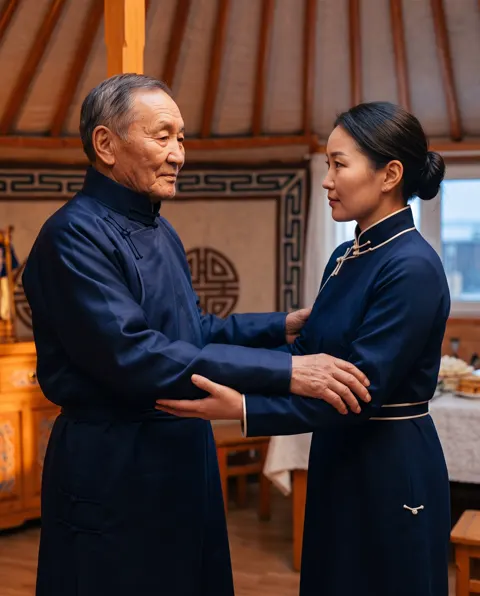
During Tsagaan Sar, greetings follow a formal physical etiquette called Zolgolt. The younger person approaches the elder and gently places their forearms underneath the elder's elbows, palms facing upward to offer support. The elder places their arms on top, receiving the greeting and touching cheeks (zolgoh) while exchanging traditional inquiries of well-being (amar mendee medeltseh).
In Mongolian pastoral family life, this gesture visually and physically demonstrates the younger generation's willingness to care for their elders. The posture reverses physical vulnerability: the young physically bear the weight of those who raised them, transforming abstract filial piety into an embodied generational covenant.
Kinship renewed
through hospitality.
A shared table in the depth of sub-zero winter.
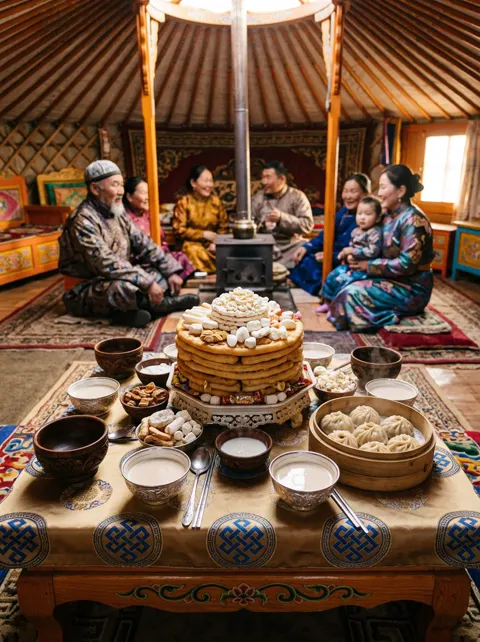
Tsagaan Sar requires families to visit the homes of senior relatives across multiple days. Every guest crossing the threshold is welcomed with hot salted milk tea (suutei tsai) and offered festive pastries (ul boov) arranged in traditional odd-numbered tiers topped with sun-dried curd (aaruul) and clotted cream (ürüm).
In a pastoral society shaped by vast distances and -30°C winter climates, hospitality was historically a prerequisite for survival. During Tsagaan Sar, it functions as an essential ritual of kinship solidarity. Families travel across snowbound valleys to actively repair and reaffirm bonds that separation would otherwise erode.
Culture learned
through living practice.
Garments, blessings, and customs passed down by example.
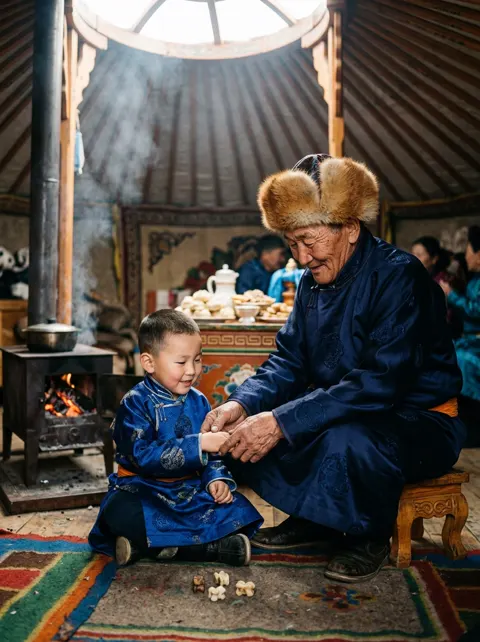
Children do not learn Tsagaan Sar through formal textbooks; they learn by active immersion. Wearing a tailored traditional tunic (deel)—a garment refined over centuries of pastoral equestrian life—young people observe their elders offering formal blessings (yerööl), sharing the ceremonial snuff bottle (khöörog), and playing traditional knucklebone games (shagai).
The Deel is a masterpiece of nomadic engineering: its deep overlapping front shields against arctic blizzards, elongated cuffs (nudarga) protect hands from frostbite, and the tightly wrapped silk sash (bús) stabilizes rider posture over long winter horseback migrations. When wearing a deel, children embody living history.
A living tradition in an
interconnected world.
Three coexisting expressions of contemporary Mongolian identity.
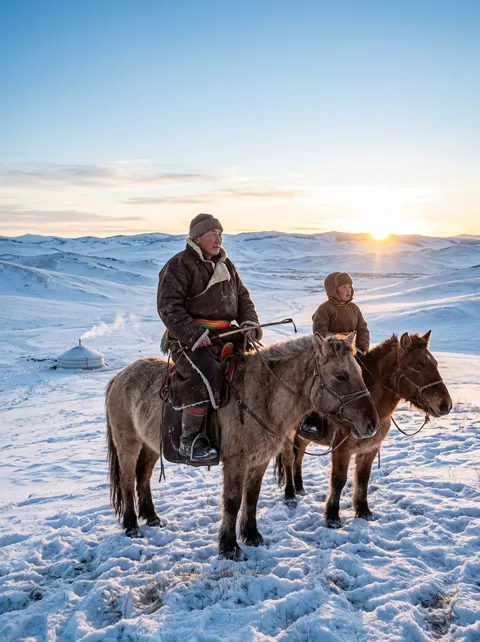
The Winter Steppe
Traditional pastoral encampments where horsemen ride across frozen valleys to perform sunrise libations and greet clan elders in remote winter pastures.
Urban Ulaanbaatar
Modern apartment living where over half the nation gathers around high-rise living rooms, steaming buuz and observing sacred kinship hierarchies.
Global Diaspora
Mongolian students and families worldwide waking before dawn, putting on deels, and video-calling grandparents across oceans to perform Zolgolt through screens.
“We inherit culture from the past.
Then we choose what to carry forward.”
A tradition endures only when each generation finds meaning in it.
Audience Discussion
In your own family or cultural background, what is an annual tradition or ritual that keeps you connected to your elders?
Verified Academic Sources
-
National Center for Cultural Heritage of Mongolia / ICHLinks:
Tsagaan Sar, celebration of the Mongolian traditional New Year. Element Record ID:13829896146331001190. Documents Bituulekh, Zolgokh, hospitality protocols, and kinship renewal. -
David Sneath (Cambridge University):
The Headless State: Aristocratic Orders, Kinship Society, and Misrepresentations of Nomadic Inner Asia. Columbia University Press, 2007 (ISBN 978-0231140546). Formal respect rituals and social hierarchy. -
UNESCO Intangible Cultural Heritage Nomination Record:
Tsagaan Sar, celebration of the Mongolian New Year. Nomination File No.00573(Official state archival ethnographic description). -
Smithsonian Center for Folklife & Cultural Heritage:
Pastoral Traditions and Living Arts of the Silk Road: The Mongolian Deel and Seasonal Cycles. Nomadic material culture and ecological adaptability.